Acoustic Seal Inspection
& Adjustment
Acoustic seals are the most critical component determining the real-world acoustic performance of any movable wall system. Worn, damaged or incorrectly adjusted seals can reduce Rw performance by 10 dB or more — regardless of the system's rated specification.
ModernGlide provides specialist acoustic seal inspection, adjustment and replacement for all movable acoustic wall and operable partition systems — all brands, nationwide.
All Seal Types
Inspected & adjusted
All Brands
Covered nationwide
Rw Restored
To rated performance
FIS Member
Accredited specialist
Acoustic Seals Explained
What Are Acoustic Seals and
Why Are They Critical?
Acoustic seals are engineered sealing components built into movable acoustic wall panels. Their purpose is to close the gaps between the panel and the surrounding building structure — floor, ceiling and side walls — when the partition is deployed in the closed position. Without these seals functioning correctly, sound travels freely through the gaps around the panel perimeter, dramatically reducing the system's acoustic performance.
The Rw acoustic rating of a movable wall system is measured in laboratory conditions with all seals in perfect contact. In a real building, achieving the rated performance depends entirely on the seals making consistent, complete contact with all surrounding surfaces. A seal that fails to close fully — even by just a few millimetres — creates an acoustic short-circuit that bypasses the acoustic mass of the panel itself.
This is why acoustic seal inspection and adjustment is the most technically important element of any movable wall service visit. A system that appears structurally sound and operates smoothly can still be delivering significantly reduced acoustic performance if its seals are worn, misadjusted or failing to engage correctly.
ModernGlide engineers are trained specifically in acoustic seal assessment — understanding the different seal types, their failure modes, adjustment procedures and replacement requirements across all major movable wall system configurations.
Seal Types
Types of Acoustic Seals
on Movable Wall Systems
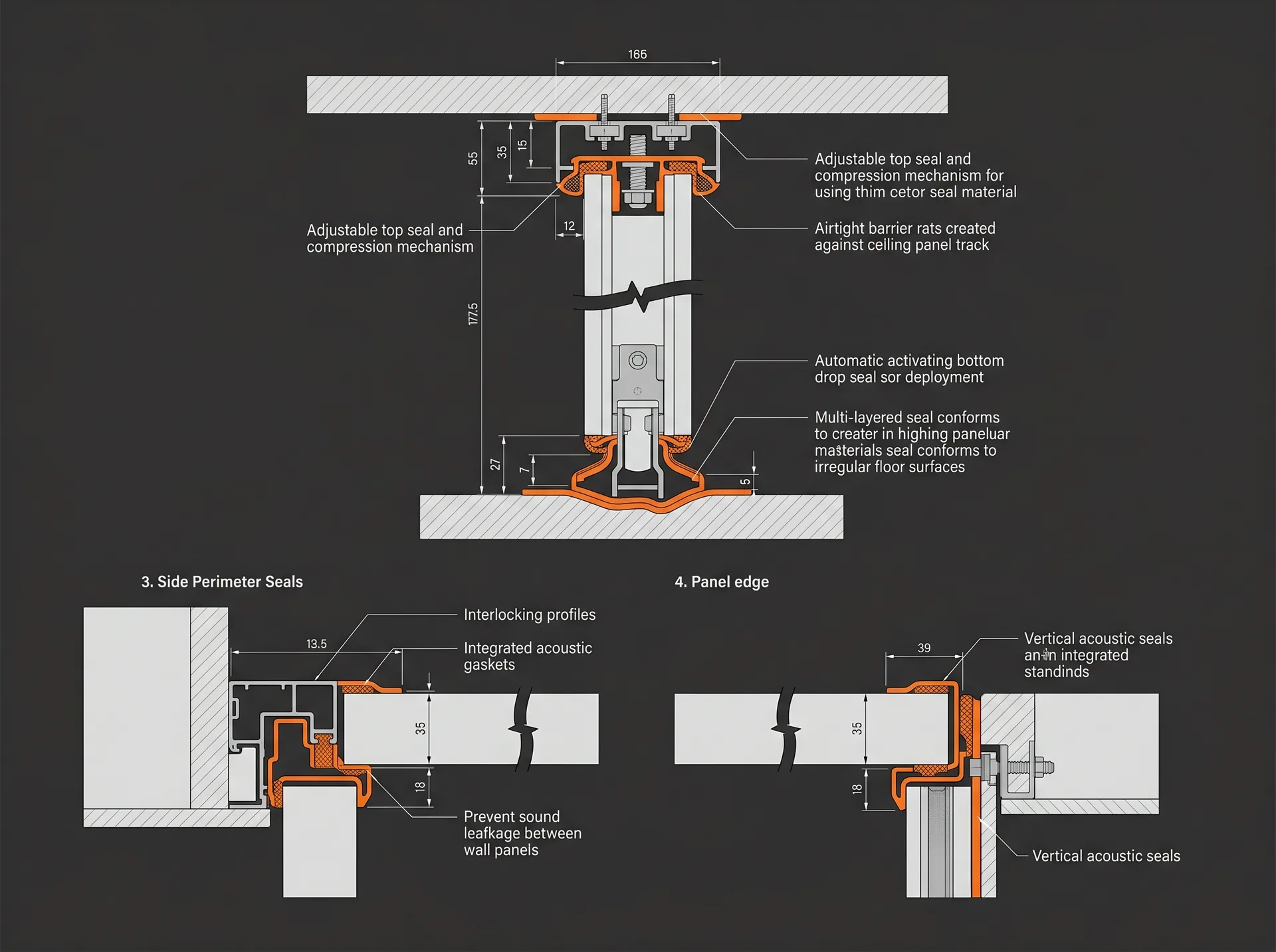
A movable acoustic wall system uses several different seal types at different junctions. Each seal type has its own failure modes, adjustment requirements and replacement procedures.
Retractable Bottom Drop Seal
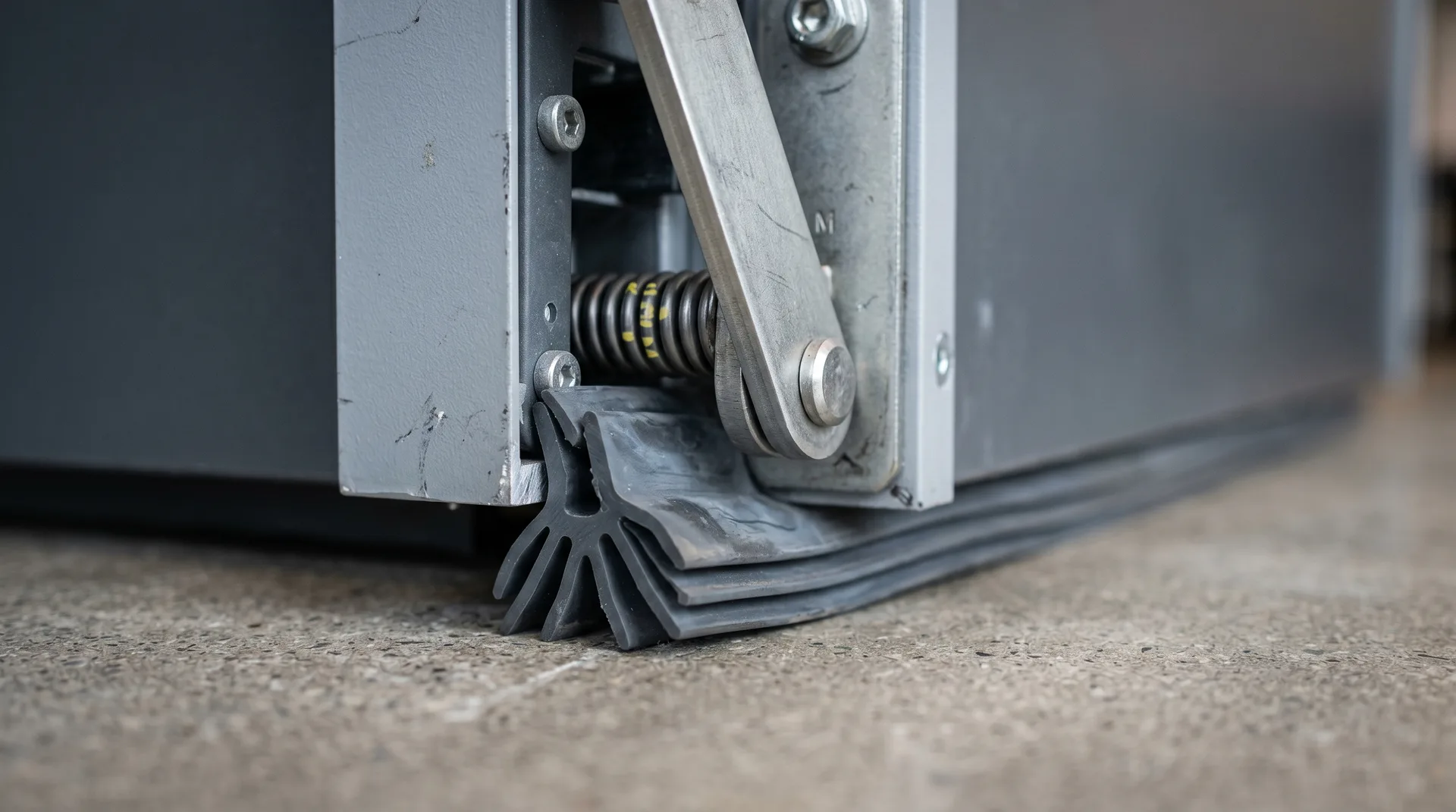
The most critical acoustic seal on any movable wall system. A spring or gravity-operated mechanism extends a rubber or brush seal downward to close against the floor when the panel is locked in position. Automatic seals activate as the panel is locked; manual seals require the user to engage them separately.
Top Seal / Head Track Seal
Seals the junction between the top of the panel and the overhead head track or ceiling structure. Top seals compress against the head track when the panel is in position, preventing sound transmission through the ceiling junction. Typically a compression rubber or brush seal.
Side / Perimeter Seals
Seals the junction between adjacent panels and between the end panel and the side wall. Panel-to-panel seals are typically interlocking rubber profiles that compress when panels are pushed together. End panel seals close against the wall reveal at the end of the partition run.
Brush Seals
Brush seals use a dense nylon or polypropylene brush pile to create a flexible seal that conforms to irregular surfaces. Used at floor, top and side junctions in some system configurations. Brush seals are particularly effective where floor surfaces are uneven or where a carpet threshold exists.
Telescopic Top Seals
Used on systems where ceiling height varies or where the panel needs to extend to fill an irregular head track profile. The telescopic mechanism allows the panel to adjust in height to maintain consistent top seal contact across the full width of the partition.
Acoustic Performance
How Acoustic Seal Condition
Affects Rw Performance
The relationship between acoustic seal condition and Rw performance is direct and significant. A movable wall system's Rw rating is achieved in laboratory conditions with all seals in perfect contact. As seals wear and their contact with floor and wall surfaces becomes incomplete, acoustic performance degrades — sometimes dramatically.
The table opposite illustrates the typical impact of seal degradation on acoustic performance. Even minor seal wear resulting in partial floor contact can reduce Rw performance by 3-5 dB — equivalent to the difference between a good and poor acoustic environment. Significant seal failure can reduce performance by 15 dB or more, rendering the system acoustically ineffective.
This performance degradation is often invisible — the system may appear to operate normally and panels may move smoothly — but the acoustic performance has been substantially compromised. Regular seal inspection is the only reliable way to identify and address this degradation before it affects the occupants of the building.
Key Fact
A gap of just 1 mm around the perimeter of a movable wall panel can reduce the effective Rw acoustic performance by 5-10 dB — regardless of the panel's acoustic mass or construction.
Impact of Seal Condition on Rw Performance
All seals in perfect adjustment
e.g. Rw 52 dB as tested
Minor seal wear — partial floor contact
e.g. Rw 47-49 dB
Significant seal wear — incomplete contact
e.g. Rw 40-44 dB
Seal failure — no floor contact
e.g. Rw 37 dB or below
Rw Performance Reference
Warning Signs
Signs That Acoustic Seals
Need Inspection or Replacement
Facilities managers and building users can often identify early signs of acoustic seal problems without specialist knowledge. The indicators below suggest that a seal inspection visit should be arranged promptly.
Not all seal problems are visually obvious — reduced acoustic performance may be the only sign that seals are failing. If occupants begin to notice increased sound transmission through a closed partition, seal inspection should be the first diagnostic step.
Acoustic Performance Issue?
Book a Seal Inspection
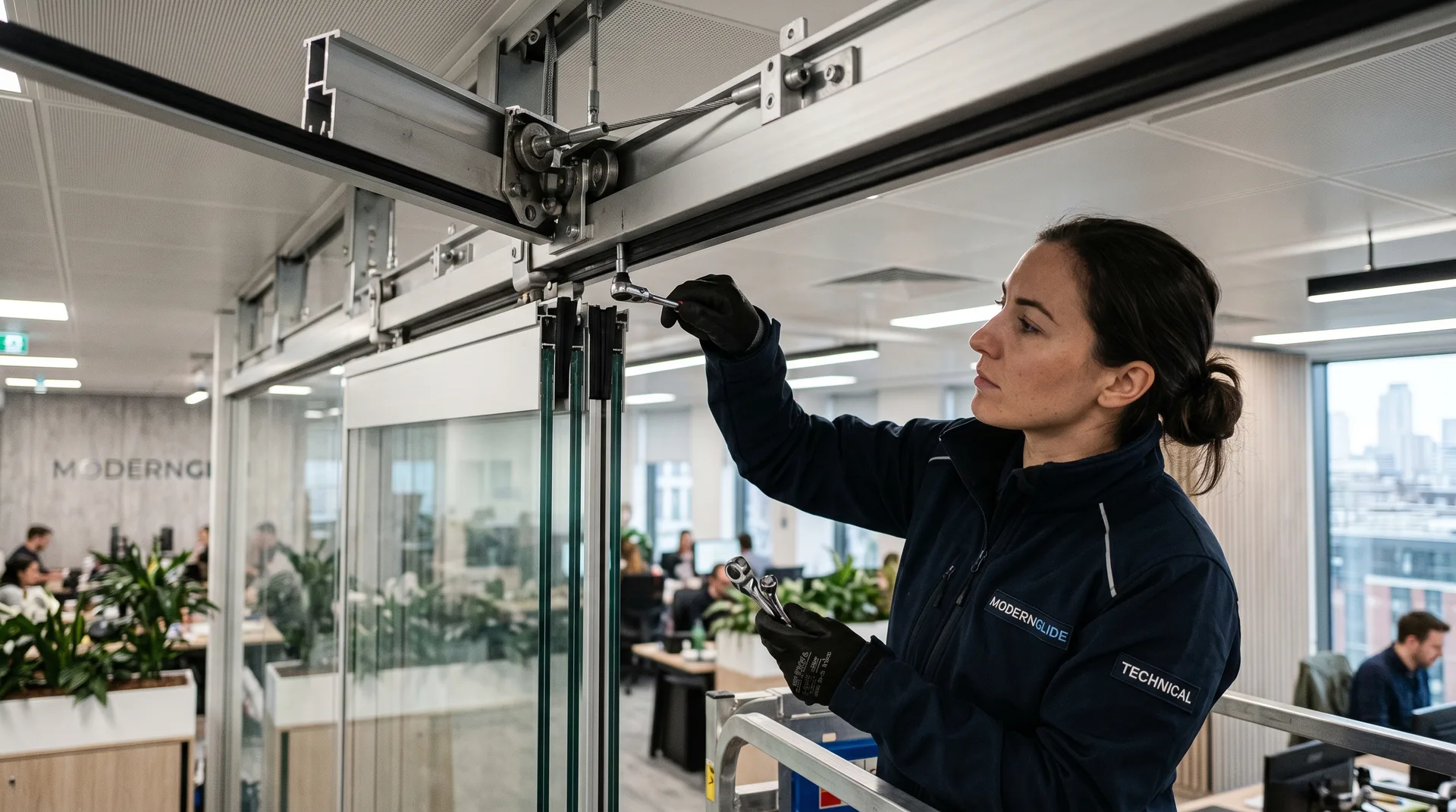
If you're experiencing reduced acoustic performance or visible seal problems, contact our team to arrange a specialist seal inspection visit. We can often diagnose and repair seal issues in a single visit.
Inspection Process
How Acoustic Seal Inspections
Are Carried Out
A ModernGlide acoustic seal inspection follows a structured eight-stage process covering all seal types and all junctions. The process is designed to identify every source of acoustic leakage and restore the system to its rated performance.
Visual Seal Condition Assessment
Each seal is visually inspected for signs of wear, cracking, compression set, physical damage or missing sections. The condition of the seal material is assessed against expected wear for the system age and usage level.
Seal Mechanism Operation Check
Bottom seal drop mechanisms are operated through their full range of movement to check for stiffness, uneven drop, incomplete extension or mechanism failure. Automatic seal triggers are tested for correct activation and release.
Floor Contact Pressure Verification
With the panel locked in position, the bottom seal contact with the floor is verified across the full width of the panel. Areas of incomplete contact are identified and the cause determined — whether seal wear, mechanism adjustment or floor surface condition.
Top Seal and Head Track Inspection
The top seal is inspected for condition and correct engagement with the head track. The head track itself is inspected for damage or distortion that might prevent full seal contact. Telescopic mechanisms are extended and checked for correct operation.
Panel-to-Panel Seal Check
With panels pushed together in the closed position, panel-to-panel joints are inspected for consistent seal contact. Any gaps or areas of incomplete seal engagement are identified and the cause assessed — typically panel misalignment or seal profile wear.
End Panel Wall Seal Verification
The junction between the end panel and the side wall is inspected for correct seal engagement. End panel seals are adjusted or replaced to ensure a tight acoustic closure at the wall junction.
Acoustic Closure Test
Following adjustment, a practical acoustic closure test is carried out — verifying that all seals are engaging correctly and that there are no audible sound paths through the closed partition. Any remaining issues are identified and addressed.
Seal Adjustment or Replacement
Seals that are worn beyond adjustment are replaced during the visit. We carry a comprehensive stock of replacement seals for all major system types. Adjusted seals are re-tested to confirm correct engagement before the visit is completed.
Inspection Checklist
Acoustic Seal Inspection Checklist
Our engineers work through a structured checklist covering all seal types and all panel junctions. A written report is issued following every inspection visit.
Visual Inspection Guidance
What to Look For
Rubber Seal Profiles
- Cracking or splitting in the rubber material
- Compression set — seal no longer springs back
- Sections of seal missing or detached
- Seal profile deformed or flattened
Seal Mechanisms
- Stiff or seized drop mechanism
- Uneven seal drop — higher on one side
- Seal not fully retracting when panel moves
- Automatic trigger not activating correctly
Floor Contact
- Light visible under the panel base when locked
- Seal making contact on one side only
- Gap visible at panel-to-panel joints
- End panel not sealing against wall
Seal Replacement
Acoustic Seal Replacement
& Rw Performance Restoration
Where acoustic seals are found to be worn beyond adjustment, replacement is carried out during the same visit wherever possible. ModernGlide carries a comprehensive stock of replacement seals for all major movable wall system types — enabling same-day seal replacement in most cases.
Following seal replacement, the system is operated through its full range of movement and acoustic closure is verified before the visit is completed. A written report is issued confirming the seals replaced, the post-replacement condition and any further recommendations.
Seal replacement restores the system to its rated Rw acoustic performance — often delivering a significant improvement in the acoustic environment immediately following the service visit.
Seal Replacement Service
Book a Seal Inspection & Replacement
Inspection Only
Full seal inspection with written report and recommendations. Suitable for scheduled maintenance assessments.
Inspection + Adjustment
Inspection with adjustment of seals that are out of correct position. Most effective for systems showing early signs of seal deterioration.
Inspection + Replacement
Full inspection with replacement of worn seals. Recommended for systems with significant seal wear or reduced acoustic performance.
Planned Maintenance
Acoustic Seal Servicing as Part
of Planned Maintenance
Acoustic seal inspection and adjustment should form part of every planned maintenance visit for a movable acoustic wall system. Seals are wear components — their condition should be assessed regularly and replacement scheduled before they fail to deliver adequate acoustic performance.
Maintain Rated Rw Performance
Regular seal inspection ensures your system continues to deliver the acoustic performance it was specified and installed to achieve. Acoustic degradation from seal wear is preventable with planned maintenance.
Identify Wear Before Failure
Seals that are assessed regularly can be replaced at the planned service visit before they fail completely — avoiding the disruption and cost of an emergency repair.
Documented Seal History
Service reports record the condition of all seals at each visit, providing a maintenance history that supports building asset management and compliance records.
Related Service
Full Movable Wall Servicing & Maintenance
Acoustic seal inspection is one element of a comprehensive movable wall service visit. Read our full guide to movable wall servicing and operable wall maintenance — covering all aspects of planned maintenance for acoustic wall systems.
Movable Wall Servicing GuideFAQ
Acoustic Seal Inspection
Frequently Asked Questions
Technical answers to the most common questions about acoustic seals, Rw performance and seal inspection for movable acoustic wall systems.
Servicing
Servicing Pages
Products
Movable Wall Systems
Technical
Technical Resources
Restore Acoustic Performance
Book an Acoustic Seal Inspection
for Your Movable Wall System
Contact the ModernGlide servicing team to arrange an acoustic seal inspection and adjustment visit. We cover all brands and all system types — nationwide UK coverage.
Acoustic seal inspection · Rw performance restoration · All brands covered · Nationwide UK