
PUWER Inspection Guide
Movable Acoustic Walls & Operable Partitions
A comprehensive technical guide for facilities managers, building owners and contractors covering PUWER obligations, inspection requirements, compliance records and recommended servicing frequencies for movable acoustic wall systems in commercial and public buildings.
Covering PUWER 1998, Health & Safety at Work Act 1974, Workplace Regulations 1992 and general maintenance duties for operable partition systems.
PUWER 1998
Compliance guidance
All Brands
Covered nationwide
FIS
Accredited specialist
Written Reports
Every inspection
Understanding PUWER
What is PUWER and Why Does it
Apply to Movable Walls?
The Provision and Use of Work Equipment Regulations 1998 (PUWER) is a key piece of UK health and safety legislation that applies to all equipment used at work. It places specific obligations on employers and those who have control over work equipment to ensure that it is suitable, safe and properly maintained.
Movable acoustic wall systems — including sliding folding partitions, operable walls and demountable partition systems — are workplace equipment within the meaning of PUWER. Where these systems are used in a workplace setting, the employer or person in control of the building has legal obligations under the regulations.
Regulation 5 of PUWER specifically requires that work equipment is maintained in an efficient state, in efficient working order and in good repair. For movable wall systems, this means ensuring that panels operate safely, that mechanisms function correctly and that all acoustic seals and structural components are in good condition. A documented maintenance record is required.
It is important to note that there is no single UK law that specifically names movable wall servicing. However, the combination of PUWER 1998, the Health and Safety at Work Act 1974 and the Workplace (Health, Safety and Welfare) Regulations 1992 creates a clear and enforceable framework of obligations for commercial building operators and employers.
Key Point
While there is no single UK law specifically requiring movable wall servicing, commercial building operators and employers have clear obligations under PUWER 1998, the Health & Safety at Work Act 1974 and the Workplace Regulations 1992 to maintain these systems in a safe and serviceable condition.

UK Legal Framework
Relevant UK Legislation
for Movable Wall Compliance
Four overlapping areas of UK health and safety law create the compliance framework for movable acoustic wall maintenance in commercial and public buildings.
PUWER 1998
Provision and Use of Work Equipment Regulations 1998
Requires that work equipment — including movable partition systems used in the workplace — is maintained in an efficient state, in efficient working order and in good repair. Regulation 5 specifically addresses the maintenance obligation. Employers and those who control work equipment must ensure it is suitable for its intended use and that maintenance is carried out to a documented schedule.
Health & Safety at Work Act 1974
Health and Safety at Work etc. Act 1974
Places a general duty on employers to ensure, so far as is reasonably practicable, the health, safety and welfare of employees. This includes ensuring that plant and equipment — including movable acoustic wall systems — does not present a risk of injury through failure, misalignment or uncontrolled movement.
Workplace Regulations 1992
Workplace (Health, Safety and Welfare) Regulations 1992
Regulation 5 requires that the workplace and its equipment, devices and systems are maintained in an efficient state, in efficient working order and in good repair. Movable walls are workplace equipment and fall within the scope of these regulations. Building owners, facilities managers and employers all have relevant duties.
General Maintenance Duties
General duty to maintain safe workplace equipment
Beyond specific legislation, there is a general common law duty of care for building owners and operators. Failure to maintain movable partition systems — particularly where panels could become uncontrolled or where acoustic seals create trip hazards — could result in civil liability in the event of an incident.
Duty of Care
Employer & Building Owner
Responsibilities
Under PUWER and the Workplace Regulations, the following parties may have maintenance obligations for movable wall systems depending on the building arrangement:
Employers
Any employer using a building with movable wall systems has a duty under PUWER to ensure those systems are maintained. This applies whether the employer owns the building or leases it — if the system is used in the course of work, the employer has obligations.
Building Owners
Building owners who provide movable wall systems as part of the building fabric have obligations under the Workplace Regulations to maintain those systems in an efficient state. This is particularly relevant for landlords who retain responsibility for building services.
Facilities Managers
Facilities managers acting on behalf of building owners or occupiers are typically the responsible party for day-to-day compliance. They should ensure movable wall systems are included in planned maintenance schedules and that inspection records are maintained.
Schools & Public Sector
Schools, local authorities and public sector organisations have specific duty of care obligations to pupils, students and members of the public. Movable wall systems in these buildings — particularly hall dividers and sports hall partitions — should be subject to regular documented inspection.
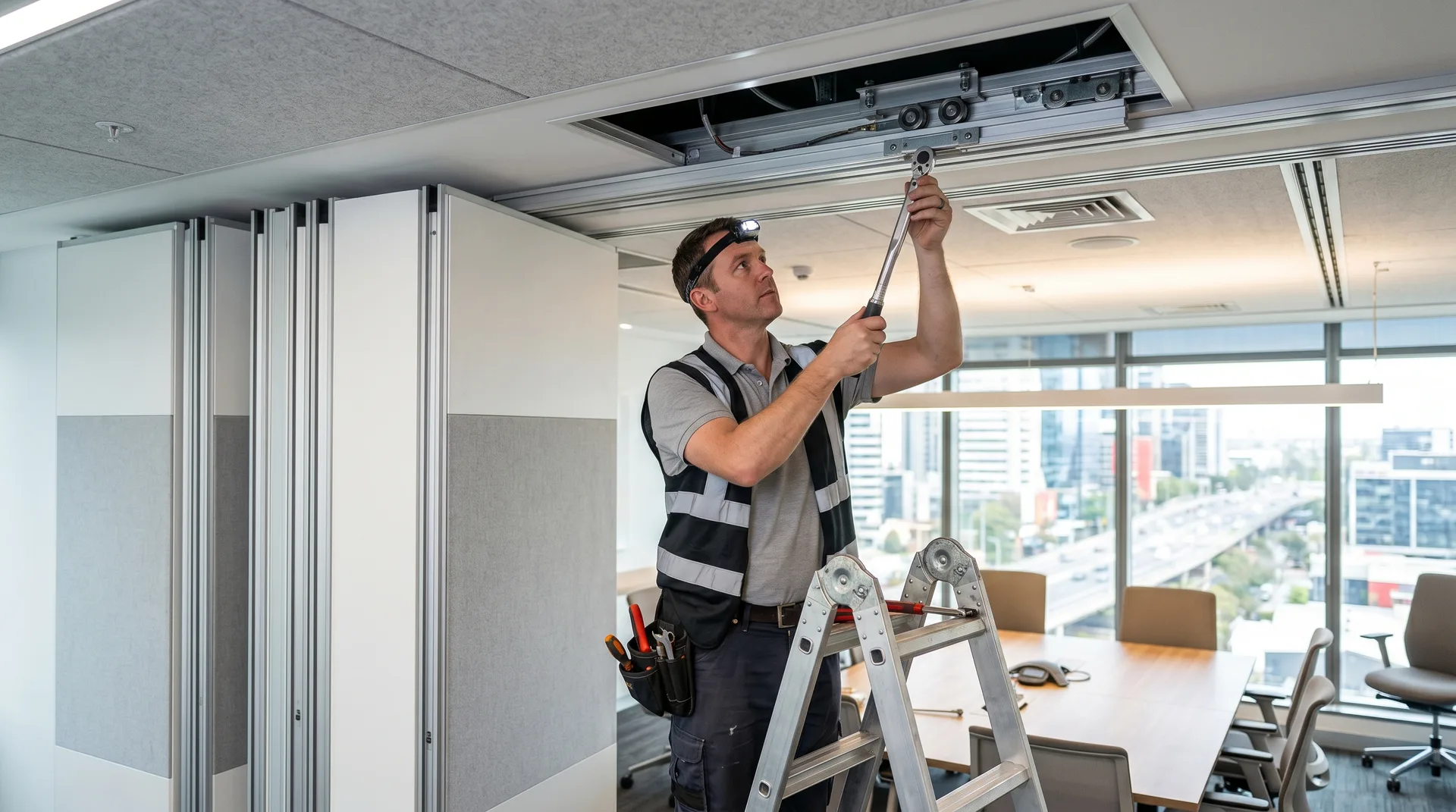
Why Preventative Maintenance Reduces Risk
How Servicing Supports Workplace Safety
Technical Inspection
Movable Wall Inspection Checklist
Typical Items Covered
A thorough PUWER-aligned inspection of a movable acoustic wall system covers six primary areas. The following checklist represents the scope of a ModernGlide inspection visit.
Overhead Track & Suspension
Trolley & Carrier Assembly
Acoustic Seal Inspection
Panel Alignment
Operational Safety
Acoustic Performance Check
Comprehensive Inspection Report Included
Every ModernGlide inspection visit produces a written report covering all checklist items, component condition ratings, seal status and recommended follow-up works. This report forms your PUWER maintenance record.
Critical Component
Acoustic Seal Inspection
& Why It Matters
Acoustic seals are the most safety-critical and performance-critical component of any movable acoustic wall system. They serve two distinct functions: providing the acoustic closure that delivers the system's rated sound reduction performance, and — in the case of retractable bottom seals — creating a positive closure against the floor surface.
From a PUWER and workplace safety perspective, acoustic seals that are worn, damaged or incorrectly adjusted can present a direct risk. Bottom seals that do not retract correctly can create a trip hazard at floor level. Seals that extend unevenly can cause panels to bind or drag during operation, increasing the force required to move them.
Acoustic seals are wear components. The rate of degradation depends on usage frequency, floor surface type and the quality of the seal material. In high-use environments such as schools and conference centres, seals may require replacement after 3 to 5 years of regular use. In lighter-use environments, seals may remain serviceable for considerably longer.
Safety Implications of Seal Failure
When Acoustic Seals Fail
Trip Hazard
Bottom seals that do not retract fully create a trip hazard at floor level — a direct health and safety risk under the Workplace Regulations.
Operational Difficulty
Seals that drag on the floor or bind against wall surfaces increase the force required to operate panels — creating a risk of sudden panel movement.
Acoustic Failure
Degraded seals allow sound transmission between spaces — defeating the purpose of the system and potentially breaching acoustic specifications.
Compliance Risk
Unaddressed seal failure is evidence of failure to maintain work equipment under PUWER — creating potential liability if an incident occurs.
Inspection Frequency
Recommended Inspection Frequencies
by Usage Level & Building Type
PUWER requires maintenance to be carried out to a schedule appropriate to the equipment and its use. The following guidance is based on typical usage patterns across common commercial building types.
Usage Level
Usage Pattern
Recommended Frequency
Typical Applications
Risk Level
Light Use
1-2 operations per week
Meeting rooms, training rooms
Moderate Use
3-5 operations per week
Commercial offices, community halls
Heavy Use
Daily — multiple operations
Schools, conference centres
Very Heavy Use
Multiple daily operations
Hotels, large event venues
These are minimum recommended frequencies based on usage patterns. Systems showing signs of wear, operating in harsh environments or used in buildings with vulnerable users (schools, care facilities) may require more frequent inspection. Our engineers provide a site-specific recommendation following an initial assessment.
Compliance Documentation
Why Inspection Records
Are Critical for Compliance
PUWER Regulation 6 requires that where the safety of work equipment depends on installation conditions or on regular inspection, equipment should be inspected at appropriate intervals and the results recorded. For movable acoustic wall systems, this creates a clear obligation to maintain written inspection records.
Inspection records serve multiple purposes: they provide evidence of compliance in the event of an HSE investigation; they create a maintenance history that allows trends in component wear to be identified; and they support building asset management and future refurbishment planning.
In the event of an incident — for example, a panel falling from its track or an acoustic seal causing a trip — the absence of inspection records would be a significant aggravating factor in any enforcement or civil liability proceedings. A documented maintenance history demonstrates that the duty of care has been exercised.
ModernGlide Service Reports
Written Reports After Every Visit
Every ModernGlide inspection and service visit produces a comprehensive written report covering all inspection items, component condition ratings, work completed and recommendations. Reports are issued digitally and archived for your records.
PPM Contracts
Planned Maintenance Contracts
For facilities managers responsible for multiple systems, our planned preventative maintenance contracts provide scheduled inspections, priority response and consolidated maintenance records.
View PPM Contract OptionsApplications
PUWER Compliance for Movable Walls
Across All Building Types
PUWER and workplace health and safety obligations apply across all commercial and public building types. ModernGlide provides specialist inspection and maintenance for all sectors.
Schools & Education
Hall dividers and sports hall partitions in schools are among the highest-use movable wall installations in the UK. Daily operation by non-specialist staff makes regular PUWER-aligned inspection essential. Schools have specific duty of care obligations to pupils and staff.
Conference Centres
Ballroom dividers and breakout room systems in conference centres operate multiple times daily. High operational frequency combined with use by members of the public creates a strong case for bi-annual or quarterly inspection and maintenance.
Hotels & Hospitality
Function room partitions in hotels are operated by a wide range of staff with varying levels of training. Regular inspection ensures systems remain safe and functional — protecting both guests and staff from risk of panel failure or uncontrolled movement.
Public Buildings
Community centres, leisure facilities and public sector buildings with movable wall systems have obligations under health and safety legislation to maintain equipment accessible to the public. Documented inspection records are particularly important in these settings.
Commercial Offices
Meeting room and boardroom partitions in commercial offices fall within PUWER scope as workplace equipment. Facilities managers are typically responsible for ensuring compliance and maintaining service records.
Universities & Colleges
Divisible lecture theatres and flexible learning spaces in higher education are subject to the same legislative framework as other commercial buildings. High use during term time makes planned maintenance contracts the most practical compliance approach.
FAQ
PUWER & Movable Wall Compliance
Frequently Asked Questions
Answers to the most common questions about PUWER compliance, movable wall inspection obligations and maintenance records for facilities managers and building operators.
Servicing
Servicing Pages
Products
Movable Wall Systems
Book a Compliance Inspection
PUWER-Aligned Movable Wall
Inspection & Compliance Support
Contact the ModernGlide servicing team to discuss your PUWER inspection requirements. We provide written inspection reports, planned maintenance contracts and compliance documentation for all movable wall brands — nationwide.
PUWER compliance · Movable wall inspection · All brands covered · Written reports · Nationwide UK · FIS accredited